


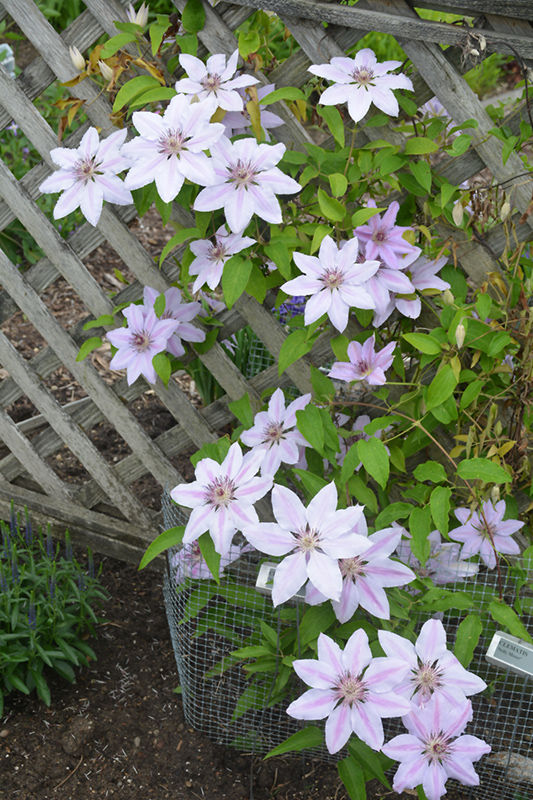
Clematis 'Nelly Moser' - Nelly Moser Clematis
$64.99
An old fashioned favorite that never seems to go out of style, this flashy climber features enormous lavender flowers with prominent hot pink bars down each petal; a real showstopper for the garden
Height: 10 feet. Spread: 24 inches. Sun: full sun. Hardiness zone: 4a.
Ornamental features
Nelly Moser Clematis features showy lavender star-shaped flowers with dark red eyes and hot pink streaks at the ends of the branches from early to late summer. It has green deciduous foliage. The compound leaves do not develop any appreciable fall color.
Landscape
Nelly Moser Clematis is a multi-stemmed deciduous woody vine with a twining and trailing habit of growth. Its average texture blends into the landscape, but can be balanced by one or two finer or coarser trees or shrubs for an effective composition.
This is a relatively low maintenance woody vine. It is a Type 1 clematis, meaning that it flowers on old wood of the previous season; other than trimming off obvious dieback in spring, it should only be pruned where necessary immediately after flowering. It is a good choice for attracting hummingbirds to your yard. It has no significant negative characteristics.
Recommended for: Accent, Hedges/Screening, General Garden Use, Container Planting.
Planting and growing
Nelly Moser Clematis will grow to be about 10 feet tall at maturity, with a spread of 24 inches. As a climbing vine, it tends to be leggy near the base and should be underplanted with low-growing facer plants. It should be planted near a fence, trellis or other landscape structure where it can be trained to grow upwards on it, or allowed to trail off a retaining wall or slope. It grows at a medium rate, and under ideal conditions can be expected to live for approximately 20 years.
This woody vine should only be grown in full sunlight. It does best in average to evenly moist conditions, but will not tolerate standing water. It is not particular as to soil type or pH. It is somewhat tolerant of urban pollution. Consider applying a thick mulch around the root zone in both summer and winter to conserve soil moisture and protect it in exposed locations or colder microclimates. This particular variety is an interspecific hybrid.
Photo courtesy of NetPS Plant Finder.
Quantity
Out of stock