

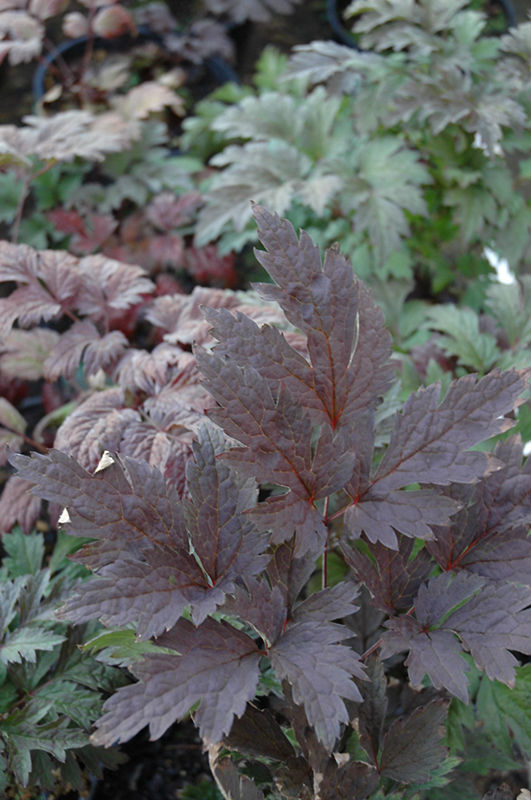
Actaea racemosa 'Brunette' Bugbane (Cimicifuga racemosa)
$34.99
Beautiful chocolate-purple, fragrant foliage and long, airy upright spikes of white flowers; prefers moist, but well-drained soil; use this plant primarily for its wonderful contrasting leaves
Height: 4 feet. Spread: 3 feet. Sun: full sun, partial shade, full shade. Hardiness zone: 4a.
Ornamental features
Brunette Bugbane is blanketed in stunning spikes of fragrant white flowers with shell pink overtones rising above the foliage from mid to late summer. The flowers are excellent for cutting. Its attractive deeply cut compound leaves emerge burgundy in spring, turning dark green in color with showy burgundy variegation and tinges of dark brown throughout the season. The brown fruits are carried on spikes from late summer to late winter. The deep purple stems are very colorful and add to the overall interest of the plant.
Landscape
Brunette Bugbane is an herbaceous perennial with tall flower stalks held atop a low mound of foliage. Its relatively fine texture sets it apart from other garden plants with less refined foliage.
This is a relatively low maintenance plant, and should be cut back in late fall in preparation for winter. It has no significant negative characteristics.
Recommended for: Mass Planting, General Garden Use, Naturalizing And Woodland Gardens, Container Planting.
Planting and growing
Brunette Bugbane will grow to be about 4 feet tall at maturity, with a spread of 3 feet. It tends to be leggy, with a typical clearance of 1 foot from the ground, and should be underplanted with lower-growing perennials. It grows at a slow rate, and under ideal conditions can be expected to live for approximately 10 years. As an herbaceous perennial, this plant will usually die back to the crown each winter, and will regrow from the base each spring. Be careful not to disturb the crown in late winter when it may not be readily seen!
This plant performs well in both full sun and full shade. It prefers to grow in moist to wet soil, and will even tolerate some standing water. It is not particular as to soil type or pH. It is somewhat tolerant of urban pollution. This is a selection of a native North American species. It can be propagated by division; however, as a cultivated variety, be aware that it may be subject to certain restrictions or prohibitions on propagation.
Photo courtesy of NetPS Plant Finder.
Quantity
Out of stock